
Description
Adaptive combustion optimization by approaching the CO/H2 threshold
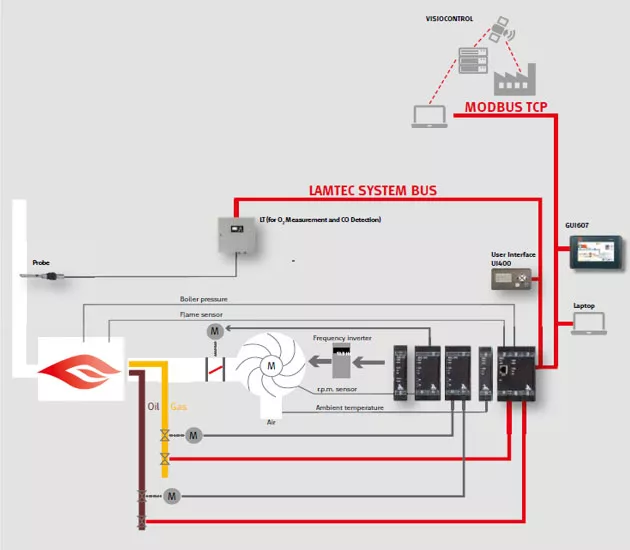
CO/H2 regulation is a software module integrated into all LAMTEC combustion management systems (CMS, BT300, ETAMATIC, etc.). Combined with the LAMTEC LT3-F/KS1D O₂/CO₂ measurement system, it minimizes fuel consumption and pollutant emissions, thus conserving resources and protecting the environment. The system features built-in safety (SIL2). A modular CO/λ regulation system, based on the LT3/KS1D, has been developed for biomass combustion systems.
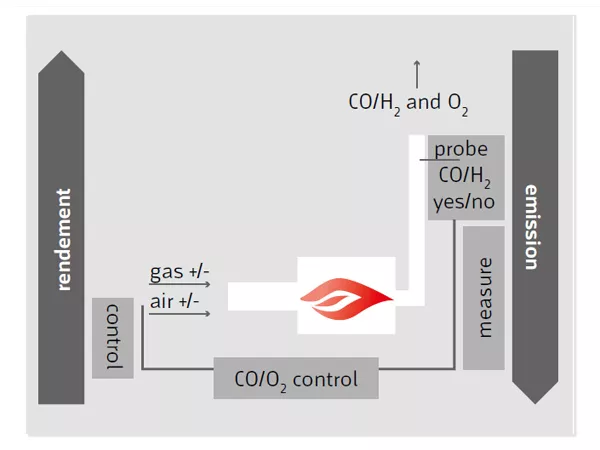
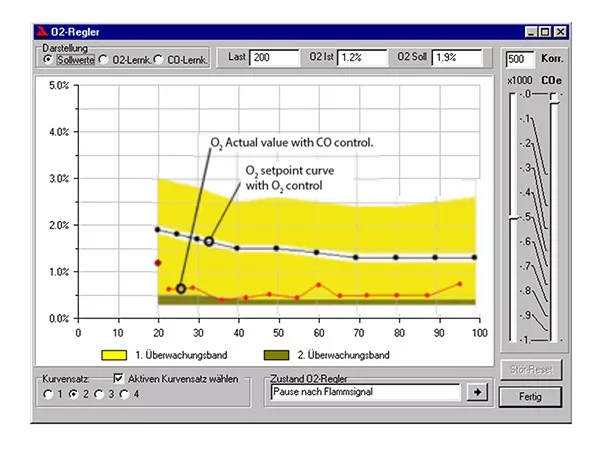
For decades, oxygen regulation has contributed to improving the energy efficiency of industrial combustion. It relies on measuring residual oxygen in the exhaust gases. Disturbances, such as the presence of extraneous air, can affect the measurement and impair the proper functioning, efficiency, and safety of the regulation. CO/H₂ regulation, integrated into LAMTEC burner and mixture control systems, compensates for these disturbances and automatically optimizes the air/fuel ratio by performing repeated cycles up to the emission threshold. At the transition point between complete/optimal and incomplete/suboptimal combustion, the emission threshold marks the point where combustion is optimized, with minimal emissions, maximum efficiency, and minimal fuel consumption.
At the emission threshold, incomplete combustion products (COe) are formed. For detecting this threshold, specially designed LAMTEC exhaust gas sensors made of zirconium dioxide are available.
The KS1D combined probe, which allows for the simultaneous measurement/detection of O₂ and COe, operates optimally with the appropriate sensor electronics, i.e., via a Lambda (LT) transmitter or via the analog output of a transmitter providing several measured variables such as O₂, COe, efficiency, etc. All variables relevant to the CO/H₂ ratio adjustment are transmitted from the transmitter to the LAMTEC burner and the mixing control system via the LAMTEC system bus (LSB).
Definition: COe is the sum of unburned components of exhaust gases such as CO, H₂ and CxH₁.